

































The Khia Asylum (Kah-yah uh-SY-lum) is a fictional “pop purgatory” asylum-style building specifically for musicians (known as Khias) who’ve yet to achieve mainstream success or cannot hold onto it for long. According to Khia lore, this meme, and the asylum as a whole is allegedly led by and named after the rapper Khia, known for her 2002 hit track “My Neck, My Back (Lick It)” who was never heard from again (her later music struggled, which in the terms of the Khia sentencing, means unadulterated radio silence needing intervention).
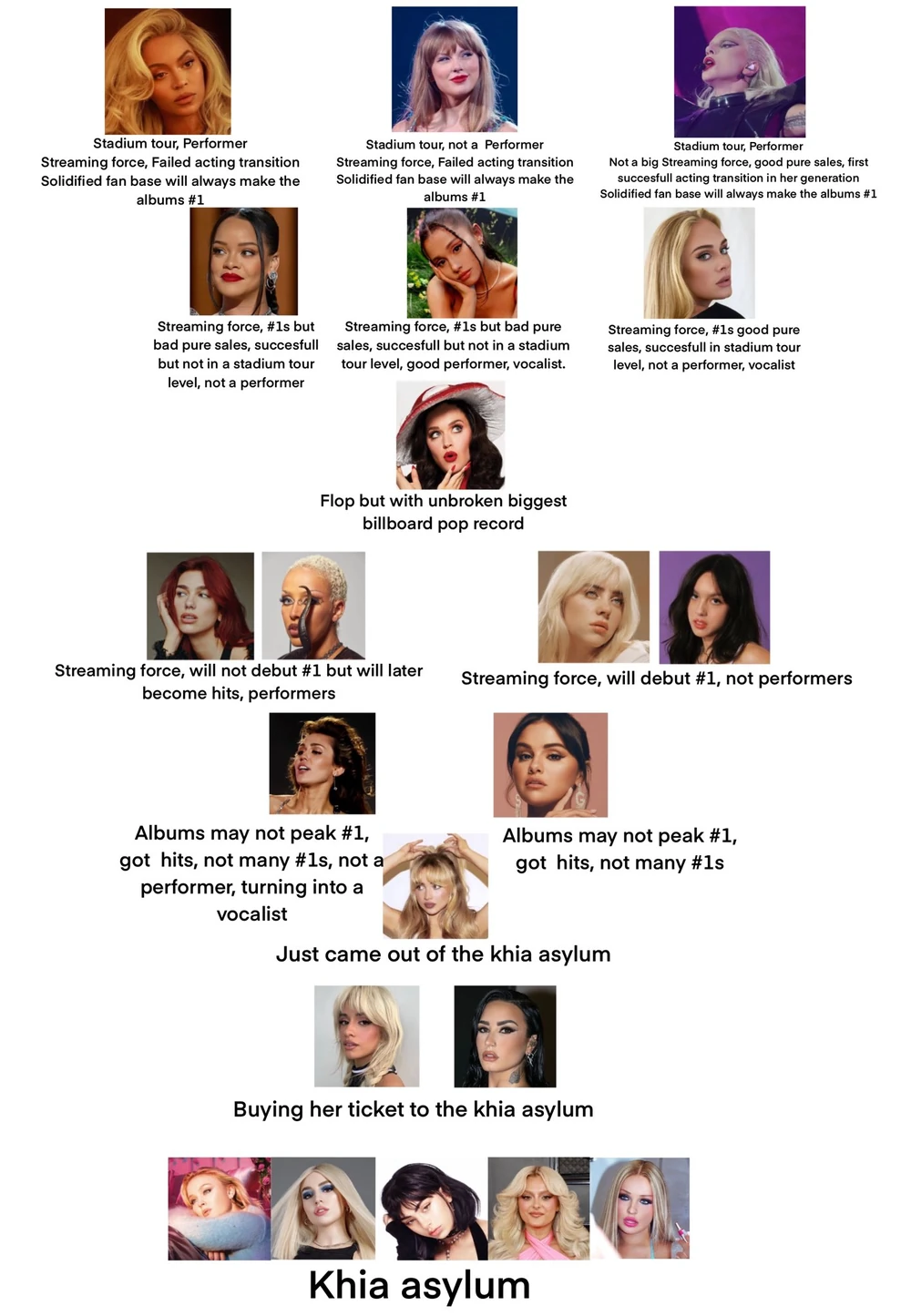
All originating in a post from @PopAteeMyHeart on the social media platform X in 2024, depicting a graph only ranking female popstars with the bottom tier being labeled as “The Khia Asylum,” caused what was only meant to be a satirical meme to bloom into an entire social concept with a devoted fandom ready to welcome “flopping” musicians into Khia’s figurative padded cells.
What exactly makes someone a “Khia”?
The exact list of inmates shifts alongside the preferences of the algorithm. The alleged sentencing requirements stay the same and, according to Floptok Wiki’s Khia Asylum page, an artist is considered a Khia when they fit the following;
- Must have little to no minor hits on charts
- Must not have a specified aesthetic
- Must not have been a well-known personality
- Must not have left any cultural impact
The Khia Asylum is home to many artists who were once very popular but due to the emergence and changes within the industry throughout the years they have begun to lose their shine, regardless if many of them were once staples within many pre-teen dominated social media spaces a few years ago. They may have a familiar voice or face that elicits nostalgia when their hits momentarily resurface, but eventually their lack of staying on top of the trends and charts causes the Khia court to allegedly continue adding years onto their sentence to better rehabilitate them the further they fall.
In a post made by Bebe Rexha in early January of 2026 captioned with “Day 3,054 – KHIA ASYLUM” the artist claimed that the fictional heads at Khia wouldn’t let her stop running on the treadmill until she “released a hit song.” The artist later announced her upcoming release titled “Dirty Blonde: The Visual Album” on Feb. 11 2026, claiming that “she was back.” and out of the “Khia Asylum.” Many have theorized that this could end up being Rexha’s ticket out, but Khia officials haven’t commented.
How do artists manage to escape the “Khia Asylum”?
Artists really have only one way to successfully escape, and ways they can go about it are:
1. Making a hit song or album
Charli XCX’s rise to fame in the aftermath of releasing her sixth studio album”BRAT” in Jun. 2024 is an almost perfect example of how successful this method could be. Despite being an established artist with an extensive catalog, opening for Taylor Swift’s “Reputation” Stadium Tour, and her track for the The Fault In Our Stars movie “Boom Clap” (2014) peaking at #8 on the U.S. Billboard Hot 100 chart, XCX had yet to grasp fame for long enough to stay out of Khia for long periods.
The release of “BRAT” (2024) finally put her on the map. With “BRAT”‘s messy, party-girl vibe, Charli XCX introduced the minimalist, more conservative leaning world of music to the joy of having a public-figure who conveys rawness in a way that doesn’t feel fabricated. Charli XCX was finally recognized after she’d been stuck in the shadows for years prior. Receiving the Grammy for Best Dance/Electronic Album of the Year and Best Dance Pop Recording for the track “Von Dutch”, XCX gave up the task of ruling the Khia Asylum, with Khia heads granting her freedom.
“I’m so happy to be out of there,” remarked XCX in a Feb. 2026 episode of Quenlin Blackwell’s FEEDING STARVING CELEBRITIES, while also acknowledging that just because she’d left once “doesn’t mean [she] isn’t going back in” and that she was “very conscious of her [current] position” within the music industry, and had even remarked on it earlier in Jan. 2026 at the private fan screening of her film The Moment (2026). Charli has recently released a new album solely for Emerald Fennel’s film adaptation of Emily Brontë’s Wuthering Heights.
However, this is the riskier option of the three. An already unpopular artist, or one that is considered “controversial” or has “flopped,” may not have a strong enough reputation for an unsuccessful new release and may end up only extending their time spent imprisoned in the asylum. Artists who have recently fallen victim to this are Katy Perry, with her album “143” (2024) and Drake’s collaborative album with PARTYNEXTDOOR “$ome $exy $ongs 4 U” (2025) which was released in the aftermath of Graham’s public feud with rapper Kendrick Lamar throughout 2024.
2. Starting a controversy
An artist’s intentional engagement in behaviors that could be considered as shocking, unhinged, or even dramatic, whether unintentional or not, can be one of the quickest ways an artist can reemerge within the public eye. Whether it be through releasing an unnecessary diss-track that is blatantly about a peer within the industry or by making a wild statement on social media that gets everyone bumbling about them within minutes, regardless of it being planned or it being unintentionally done, it ends up with eyes on them and the Khia heads find an empty cell in the morning.
A more extreme display of this phenomenon is rapper Kanye West, or Ye, who has been the topic of many controversy’s throughout his musical career but has grown increasingly more frequent and extreme due to a suspected decline of his mental health. From jumping into a nineteen-year-old Taylor Swift’s space on stage at the 2009 Grammy Awards, allegedly making numerous offensive comments on his Twitter account, and showing up uninvited to the 2025 Grammy’s red carpet that ended up with an internet blow-up over the outfit his wife Bianca Censori was wearing that night, these extreme actions have kept him from ever receiving a Khia sentencing, regardless of how frowned upon his actions were, and have kept many an artist out as well in the past for as long as the media would continue to discuss them.
3. Quitting music
A last resort method, but the fastest one to date to get out of the Khia Asylum – quitting music altogether. Upon formally exiting the industry itself, Khia officials are no longer allowed to hold the certain imprisoned artist, and they are free to do whatever awaits them beyond the dictating patterns of monthly listeners and the dilapidated building of Khia that they used to see as home.
In the end, the concept of the Khia Asylum almost perfectly depicts the endless and irresistible drama that lies at the very heart of the music industry, the fire that keeps it all going – the dazzling rise, the scathing fall, and the inevitable rebirth of a brand-new star all in the same body and career of one singular artist, even if they have spent a majority of their career as a Khia prisoner rather than a musician. Within each of its figurative cells, the stakes of finally finding one’s success is magnified tenfold for each artist as the trend-cycles continue to shift and the industries gender barriers begin to change alongside society. And yet, one could presume that the sweetest part of it all isn’t making Billboard’s top ten, but rather finally stepping out of the prison for popstars.