




















After it was tested in the MiLB, MLB spring training, and the 2025 All-Star Game, the automated ball-strike (ABS) challenge system has been confirmed for the 2026 MLB season.
Previously, ball and strike calls could not be reviewed whatsoever, but now, each team can challenge calls using a robotic reviewing system. After the MLB announced that it will be integrated into the 2026 season, it instantly became a controversial topic.
The goal of the system is to have increased accuracy with strikes and balls. Many people say that the system will increase accuracy in ball and strike calls and be useful in big moments. “If you have the opportunity to get it right, so, if this is a chance for them to make sure that we’re getting, especially big, meaningful calls correct, then I’m totally for it…” Mr. Jim Plaza, GCHS softball coach and social studies teacher, said. However, others argue that ABS removes a human element from the game. Does every call really need to be perfect? Is it worth replacing human calls with robotic calls just in order to do so? “Human error is part of the game. Players make mistakes, coaches make mistakes, umpires make mistakes,” GHCS baseball coach Troy Whalen said. To get a better understanding of this system, let’s take a closer look at both sides of the argument.
How much will it impact the game?
One of the major arguments made in favor of the system is that it truly has the power to influence any given moment of a game. “Any pitch that goes one way or the other can really change the outcome because every at-bat is based off the last pitch. The way you pitch 0-1 [counts] is different than the way you pitch 1-0,” Mr. John David, Life Fitness department chair said. Others believe that the calls can’t singlehandedly change the outcome of the game. Coach Whalen says that he thinks that “They’re gonna give it a try, I think they’re gonna find that the improvement rates that they were looking at probably aren’t gonna be there…” and that “There’s never one call during the course of a game… that causes a team to lose the game.” We can get a good idea of its realistic impact by looking at some statistics. In the 2025 MLB regular season, umpire accuracy ranged from about 91-96%, according to umpscorecards.com. For the usage of the system, in the 2025 Triple-A MiLB season, the games averaged 290 pitches per game, and the ABS system was used only 4.2 times on average per game, with a 52.2% overturn rate.
What do fans and professional teams think of it?
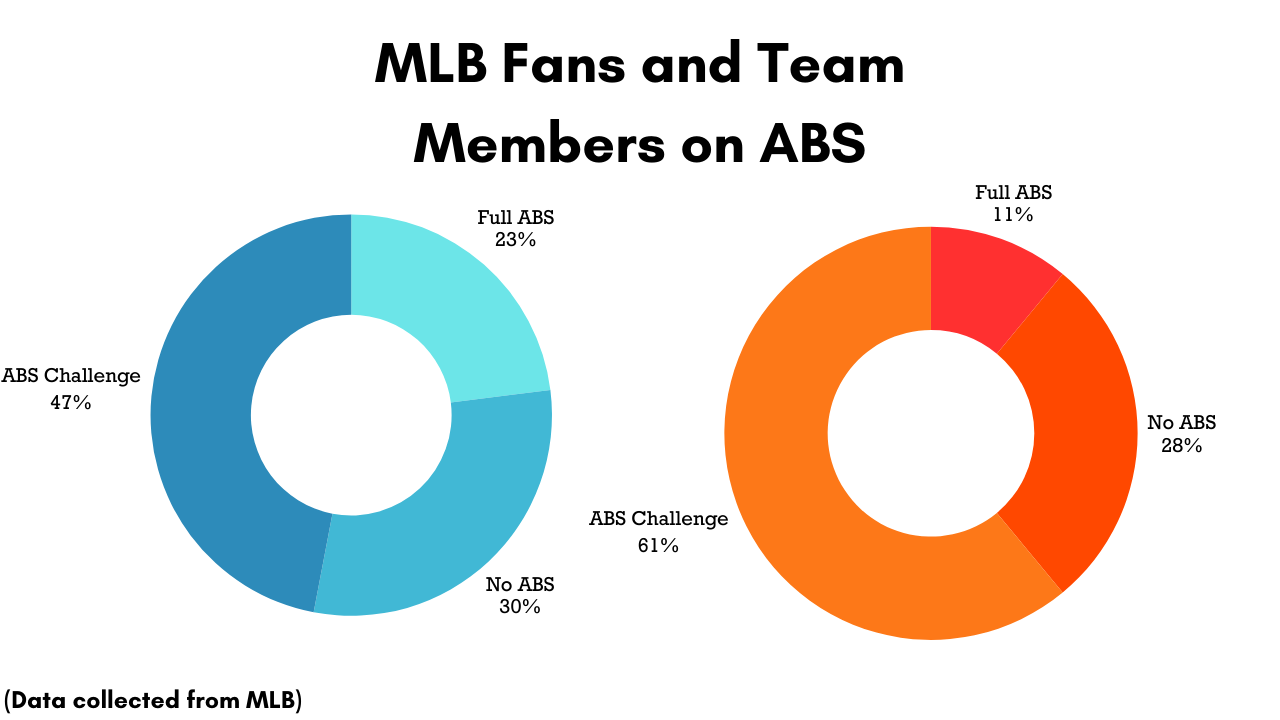
A survey conducted by the MLB revealed a lot about how team members (coaches, players, etc.) feel about ABS, and how fans feel about it.
Fans: About 30% of fans think that there should be no ABS whatsoever, and that all ball and strike calls should be decided by the home plate umpire. 47% are in favor of the ABS challenge system, and just 23% think that all strikes and balls should be called by a robot umpire.
Team members: 28% of MLB team members think there should be no ABS system, 61% believe that there should be an ABS challenge system, and only 11% would be in favor of a full robot umping system.
Other Big Factors at Play
Aside from the two main arguments made, there are some other aspects of baseball that ABS could effect. To start, this is the first time that players, rather than managers have been able to challenge calls. Mr. John David brought up the point that it’s common for hitters to argue with the umps. He said, “We see huge fights and arguments with umpires every game… why wouldn’t they want to eliminate those arguments with the umpires?” Another thing to think about is the strike zone. Every umpire has a different strike zone. Some like to call high pitches, some like to call low ones. Because of this, hitters have to adjust to different umpires’ strike zones. Some argue that these adjustments have become part of the game, and that the best hitters are flexible when it comes to different umpires. The opposing side of this is that hitters can prove that they know the strike zone well by challenging missed calls. “It’s gonna allow them to show how much of a command of the strike zone they actually have,” Mr. Jim Plaza said.
Is it worth it?
There’s no doubt that the system will have both benefits and drawbacks in many different fields of the game. Both sides of the argument have interesting and fair points. It’s also important to note that it is still very unknown how the system will turn out. However, looking at it overall, given the already decently high accuracy of MLB umps, and the low usage of the system, it seems like an unnecessary change. As mentioned earlier, in Triple-A, only an average of 4.2 calls per game were challenged, and about 52.2% of challenges were successful. The question remains: is it worth sacrificing a human aspect of the game to strive for perfect accuracy?